The Theft of Debt
In 2016 when Timothy Stauffer Jr. accepted the call to pastor Glad Tidings Church of Hancock, Michigan, the mortgage plus sky-high utility and upkeep bills were consuming tithes and offerings. Nothing remained for outreach.
Stauffer knew that scenario all too well.
“Every church I’ve been to was way too comfortable with being in debt,” he says. He also knew it doesn’t have to be that way.
Although his dream of financial freedom seemed impossible, he led the congregation to put feet to it: “On day one, the goal was getting out of debt,” he says.
A decade later, boosted by several anonymous donations to retire $140,000 of the mortgage, Glad Tidings achieved that goal of becoming debt-free.
Hancock, population 4,500, the state’s northernmost city, is home to Michigan Tech; residents are the most educated of all cities in Michigan’s Upper Peninsula. Yet Houghton County, where Hancock’s located, is tied with another county as the Upper Peninsula's poorest per capita. One in three households is occupied by an elderly person living alone.
Needs abound in the community, but big financial burdens hamstrung the church from funding outreach ministry. Planted in 1970, Glad Tidings is the only Assemblies of God church within a 30-minute drive of Hancock. Soon after the church built a new facility in 2000, its dwindling, aging congregation found itself straddled with outsized payments on a $420,000 mortgage.
Stauffer, 45, graduated from Central Bible College in 2002 with a heart to pastor small, hurting churches. At 21 he became senior pastor of a rural Illinois church with nine congregants and a $1,000 monthly mortgage payment.
“My last Sunday there, we paid off the mortgage and paid cash to renovate the church,” he says.
Soon after Stauffer accepted the call to pastor Glad Tidings, he asked the bank how much interest the church had paid since taking out the mortgage in 2000. The answer shocked him: more than $500,000.
“What could that money have done if it had been invested into ministry, souls and discipling?” he wonders aloud. “Instead, they paid it to the bank.”
“That’s why debt is such a thief—it robs the church of its mission” Stauffer adds.
After accepting the position and the challenges that arose from indebtedness, Glad Tidings’ new pastor declared, “We’re not going to increase the debt. We’ll pay for any problems with cash.”
That was no easy endeavor; the church was behind on bill payment. Monthly utilities plus snow removal cost almost as much as the mortgage. In recent years the facility needed a new roof, furnace overhaul, and a full window replacement across the front of the building.
It’s no easy shift to move those accustomed to easy credit to pay as they go.
“That’s probably the hardest battle—people’s mindsets,” he says. Congregants typically address costly expenses such as the windows and furnace by borrowing funds. Instead, Stauffer used the occasion to teach faith and stewardship.
Individual congregants took on paying for and supplying labor for vital repairs. Stauffer and his dad worked on the furnace. Other volunteers reroofed the building. Two families paid for the windows.
The second step: “We’ve got to start paying off the debt,” he recollects telling his congregation, adding that “a little adds up to a lot.” To that end, his rule of thumb for getting out of indebtedness was to pay a little extra toward the principal each month.
“Maybe $100 to $200 extra, but it adds up over time,” he notes.
In 2021 the church renegotiated a 15-year loan at a lower rate, which dropped the monthly payment by $1,150; they put an additional $400 each month toward the principal. By early 2025, the debt had plummeted from $420,000 to $172,000.
“A lot of churches think God is just gonna drop the money in their lap—a check in the mail” he says. In contrast, drastically reducing the church’s loan was a miracle of stewardship and sacrifice, “disciplining ourselves to pay for upgrades and maintenance with cash,” Stauffer says.
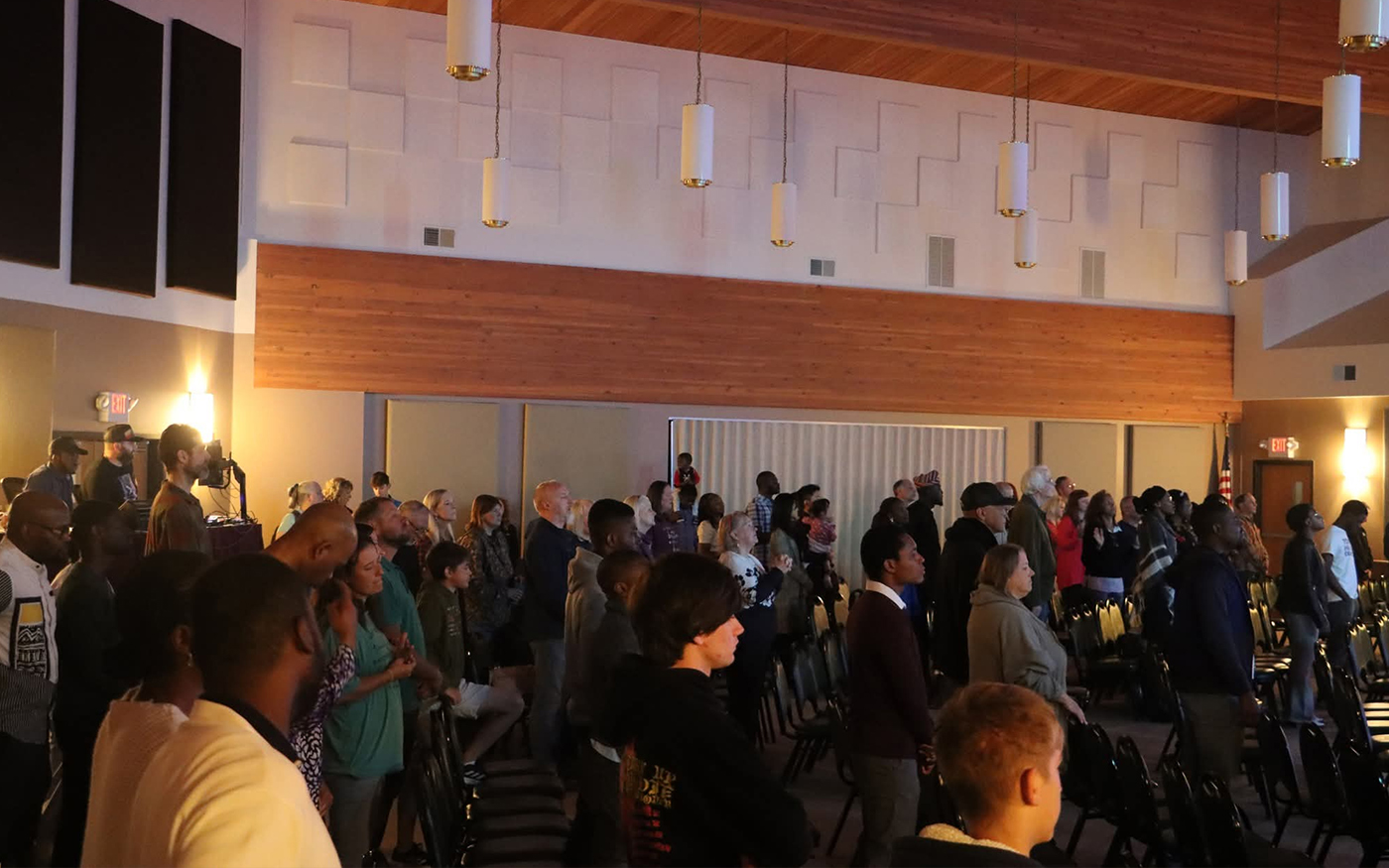
Meanwhile, church attendance rose to 150, most of whom came to faith in Christ through Glad Tidings. While the congregation is predominantly young families, attendees in their 70s have gotten saved. The once mostly white congregation now includes congregants from Africa and Asia.
In August, a family anonymously gave $20,000 toward the mortgage. The same January week Stauffer planned to preach on tithing, another family anonymously gave a $60,000 gift. A day later, a third family matched the $60,000 donation. All these gifts were unexpected and surprised the pastor and his staff.
The board voted to pay off the remaining $3,500. On February 10, church administrator Jennifer Ormsbee typed a note on the last online payment: “Praise God, we are no longer in debt!”
“The miracle we experienced wasn’t overnight but a lot of stewardship and faith over 10 years,” Stauffer says.
“It’s a great picture of God’s faithfulness and the generosity of his people,” says Sharon York, 65, Wisconsin/Northern Michigan Ministry Network secretary/treasurer.
“Sometimes you’ve got to do hard stuff and make hard decisions, but when you walk in what God tells you to do, He takes care of you,” York says. “It’s the Word, it’s truth, and you can stand on it.”
As the church plans to celebrate the retirement of debt with a party, Glad Tidings congregants are praying for the Lord to reveal their specific mission to the community with newly available funds for increased outreach.